The lowcountry terrain around Savannah, Georgia doesn't give up its secrets easily. What looks like flat, stable ground from above often conceals a hidden world of paleochannels, buried marsh deposits, and solution cavities in the underlying limestone. The humidity and shallow water table—typical for Chatham County—create a near-surface environment where traditional drilling alone can miss critical lateral variations. Seismic tomography (refraction/reflection) bridges that gap. When we run a 24- or 48-channel spread across a site near the Savannah River, the resulting velocity profiles reveal compressional and shear wave boundaries that correlate directly with engineering stratigraphy. Before finalizing foundation type, it's common practice to integrate these results with spt-drilling to calibrate N-values against seismic velocities, especially where the Hawthorne Formation shallows toward the Fall Line. Our team has deployed this method on everything from warehouse pads in Pooler to bridge approach studies along I-16, and the data consistently helps engineers avoid surprises during excavation.
We've mapped velocity inversions beneath Savannah—soft zones under stiffer crust—that only seismic tomography can resolve without disturbing the sample.
Process and scope
Local ground factors
In Savannah, setting up a 48-channel seismic spread requires directly addressing the coastal plain's surface conditions. During summer afternoons, thunderstorms saturate the topsoil and fill swampy depressions with water, giving the trigger switch on our weight-drop source a heavy workout. To maintain consistent contact, geophones in saturated organic silt must be carefully planted, sometimes using a sandbag of dry material. Around industrial sites near the port, background vibration from container handling equipment and truck traffic can degrade the signal-to-noise ratio; we mitigate this by stacking shots and scheduling early-morning acquisition windows when ambient noise is lower. A major interpretation challenge is velocity inversions, a frequent scenario where a stiff desiccated clay crust overlies softer, normally consolidated clay. Standard refraction processing would overlook this, so we use tomographic inversion algorithms that handle low-velocity layers. In the Savannah metro area, every line we shoot includes multiple reciprocal shots and at least three-fold subsurface coverage to verify consistency before passing data to the engineering team.
Reference standards
Applicable standards are ASTM D4428/D4428M-14 for crosshole seismic testing methods, ASTM D5777-18 as a guide for subsurface investigation via seismic refraction, and ASCE 7-22 Chapter 20 for site classification procedure for seismic design.
Other technical services
Seismic Refraction Tomography
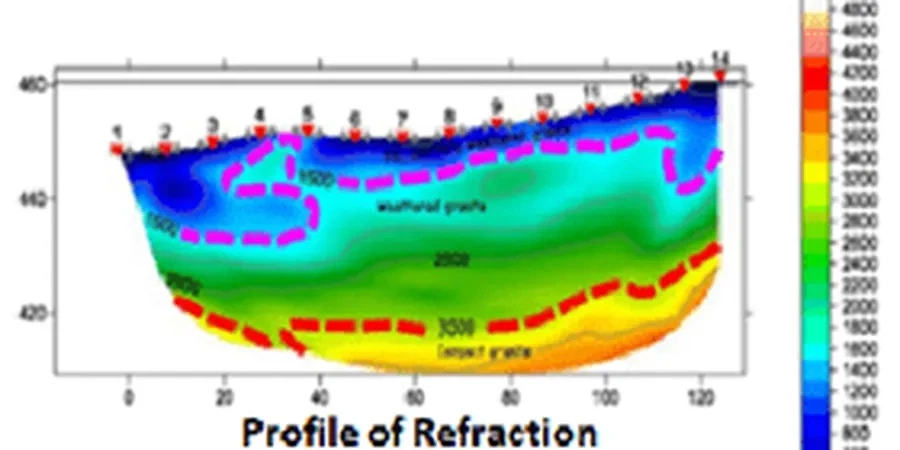
This technique maps the top of competent bearing strata—commonly the Coosawhatchie or Marks Head formations in the Savannah area. With 4.5 Hz geophones spaced at 10 to 20 feet, we generate velocity cross-sections that distinguish soft alluvial silts from dense sands. Typical survey depths reach 60 to 100 feet using a sledgehammer or accelerated weight drop source. The data feed directly into site class determination per ASCE 7-22 Chapter 20 and help position test-pits in representative locations.
Seismic Reflection for Deep Bedrock Mapping
Reflection profiling is the preferred method when the target is the top of the Floridan Aquifer limestone, which lies 200 to 400 feet below Savannah. We employ a 48-channel array with single-geophone groups and a more powerful energy source to capture reflections from deep impedance contrasts. The processed sections reveal karst features, fracture zones, and areas prone to subsidence, all of which influence deep foundation design and groundwater modeling.
Typical parameters
Q&A
What is the typical cost for a seismic tomography survey in Savannah?
In the Savannah area, costs for a standard refraction line of 230 to 345 feet (24 geophones) range from US$2,340 to US$5,010, influenced by access conditions, source type, and whether reflection acquisition is included. Urban sites requiring asphalt cutting and traffic control tend to fall at the upper end of this range.
How do you handle high groundwater interference during seismic surveys near the Savannah River?
A shallow water table enhances P-wave refraction transmission since saturated soils have higher velocities than dry ones. In reflection surveys, we might modify the source offset to prevent strong ground roll and water-column multiples; our processing workflow incorporates F-K filtering and deconvolution routines to clean up the section.
Can seismic tomography detect sinkhole potential in the Savannah area?
Dissolution features in the Floridan limestone cause velocity anomalies that appear as low-velocity zones or disrupted reflectors on processed sections. We have mapped several paleosinkholes beneath industrial sites west of I-95, where velocity drops of 40% or more indicated raveled zones that needed further investigation with targeted borings.
How long does a seismic tomography survey take, and will it disrupt my construction schedule?
A single 24-channel refraction line typically requires one field day for layout, shooting, and demobilization. Data processing and interpretation are finished within three to five business days. We coordinate with contractors in Savannah to schedule the survey during site clearing or before heavy equipment mobilization.