Too many projects in Savannah break ground with a basic soil report that ignores the compressible marine clay layers beneath the surface, and six months later the footings show differential settlement. What looked like competent sand at five feet turned out to be a thin lens over thirty feet of soft, high-plasticity clay that consolidates slowly under load. We see this pattern from Pooler to Skidaway Island because the Pleistocene-age deposits here are not uniform; they shift laterally within a single lot. A soil mechanics study that includes Atterberg limits and consolidation testing maps exactly those transitions before the first yard of concrete is poured, and in Chatham County's 30-foot-deep vadose zone those transitions matter more than the bearing capacity number alone.
Savannah's marine clay consolidates slowly. A soil mechanics study that skips consolidation testing will underestimate total settlement by 40 percent.
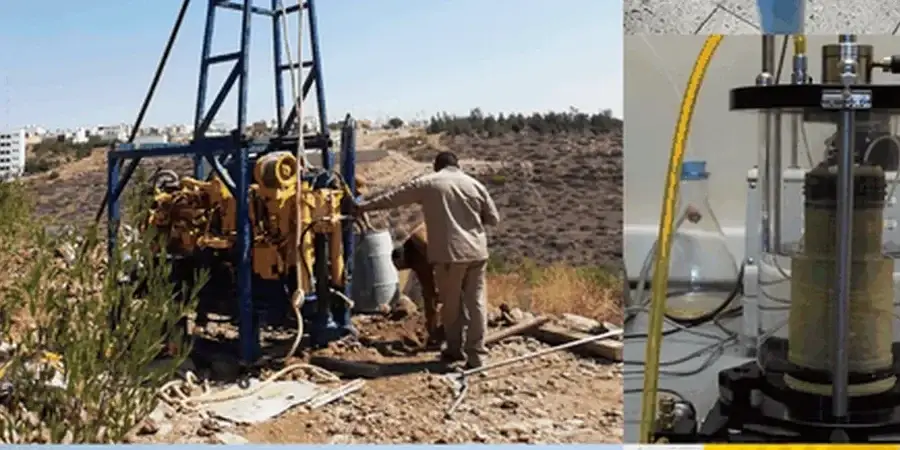
Process and scope
We run particle-size distribution on every sample because gravel lenses appear unpredictably in the Pleistocene terrace deposits near the Savannah River, and a missed gravel seam changes the drained shear strength by 20 percent or more. Proctor compaction curves for fill placement are calibrated to the local borrow sources around Garden City and Port Wentworth, where the fines content varies enough to shift optimum moisture by three percentage points from one truckload to the next.
Local ground factors
Until the 1950s, Savannah's expansion was limited because drainage projects were needed to convert marshland into developable lots. This history is evident in every soil boring east of Truman Parkway. The fill placed over tidal marsh deposits rarely exceeds four feet in thickness, and the underlying organic silt continues to compress under structural loads even after fifty years. The hazard is not sudden failure but gradual differential settlement, which causes cracking in slab-on-grade floors and separation of brick veneer from framing. On Hutchinson Island and along the Vernon River, the combination of loose dredge spoil and sulfate-rich groundwater degrades standard concrete within a decade. A soil mechanics study that evaluates consolidation rate and sulfate exposure enables the structural engineer to select the appropriate cement type and reinforcement cover prior to mix design at the batch plant.
Reference standards
The relevant standards include ASTM D2487-17 for USCS classification, ASTM D4318-17 for Atterberg limits, ASTM D4767-11 for triaxial compression, ASTM D2435 for consolidation, IBC 2021 Chapter 18 for soils and foundations, and AASHTO T-88 for particle size analysis.
Other technical services
Standard Soil Mechanics Package
For shallow foundation design on Wando Formation sands and upper clay layers, index properties along with direct shear or triaxial strength are used. The study includes USCS classification, Atterberg limits, Proctor compaction, and consolidation parameters for settlement analysis under IBC allowable bearing pressures.
Advanced Marine Clay & Deep Foundation Study
Sites underlain by more than ten feet of Cooper Marl or organic marsh deposits require full consolidation and shear strength profiling. This involves triaxial testing with pore pressure measurement, calculation of consolidation rate, and sulfate/pH screening for concrete durability. Such testing is recommended when evaluating pile-supported slabs or mat foundations.
Typical parameters
Q&A
What does a soil mechanics study cost for a residential lot in Savannah?
For a typical single-family residential lot in Chatham County, a soil mechanics study including index properties, consolidation, and shear strength costs between US$2,980 and US$5,180. The price varies based on the number of borings required, the depth to marine clay, and whether triaxial or direct shear testing is necessary. Sites near marsh boundaries or with a history of fill placement typically fall at the higher end of the range.
How deep do borings need to go for a Savannah soil mechanics study?
According to IBC, borings must penetrate through all compressible strata that could cause settlement. In Savannah, this means reaching the Cooper Marl or a deeper competent stratum, usually at depths between 30 and 55 feet. If deep foundations are being considered, borings should extend at least 20 feet below the anticipated pile tip elevation.
How long does the lab testing take after field sampling?
Standard index testing, such as grain-size distribution and Atterberg limits, requires three to five business days. Consolidation and triaxial tests take longer because saturated clay specimens need incremental loading or shearing at controlled strain rates. Expect seven to ten business days for the complete engineering report.
What is the biggest foundation risk in the Savannah area?
The primary risk is long-term consolidation settlement in the marine clay layers. These clays have low permeability and drain slowly, causing settlement to persist for years after construction. Secondary compression in organic-rich marsh deposits compounds this, making a properly interpreted consolidation test the most critical data point in the study.