Savannah sits at barely 15 meters above sea level, and the 1886 Charleston earthquake—magnitude 7.0, felt strongly here—reminds us that the coastal plain doesn't need a nearby epicenter to shake. Much of Chatham County overlies loose, saturated sands from the Pleistocene and Holocene, exactly the profile that triggers liquefaction when ground acceleration exceeds 0.15g. We run site-specific liquefaction analysis following Seed & Idriss simplified procedure, using SPT data corrected for overburden and energy ratio, plus fines content from lab tests, to calculate factor of safety at each critical depth. When the geotechnical report needs to satisfy ASCE 7-22 and the Georgia State Amendments, we combine field investigation with CPT testing where sands are too uniform to sample well, and grain size distribution to confirm liquefaction susceptibility in silty layers.
Liquefaction doesn't just mean sand boils—it means total bearing loss. In Savannah's loose alluvial deposits, a factor of safety below 1.2 demands either ground improvement or deep foundations.
Process and scope
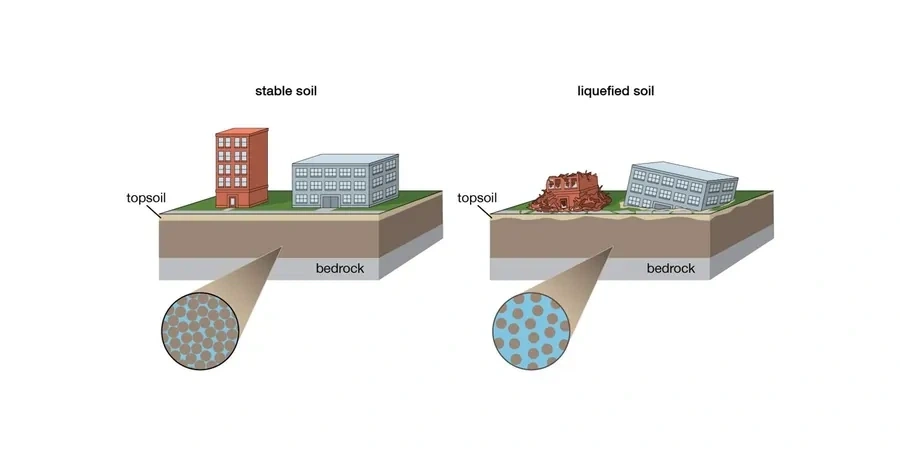
Local ground factors
The Savannah River and its tributaries have deposited thick sequences of loose sand, silty sand, and soft clay across the city. Combine that with a shallow water table that rises within 3 to 6 feet of the surface during wet years, and you get a subsoil that's primed for liquefaction even under moderate shaking. The risk isn't theoretical—historic accounts from the 1886 event describe ground cracks and sediment ejection near the riverbanks. Modern site response analyses for downtown Savannah often show amplification of long-period waves in the soft soils, which increases cyclic stress ratio in the upper 30 feet. If the factor of safety drops below 1.0 at any layer, the building code requires mitigation. We specify ground improvement—stone columns for drainage and densification, or vibrocompaction for cleaner sands—or switch the foundation design to deep piles that bypass the liquefiable zone entirely.
Reference standards
Key standards employed include the NCEER (Youd & Idriss 2001) methodology for soil liquefaction resistance, ASCE 7-22 for design loads, ASTM D2487-17 for classification, ASTM D1586-18 for penetration testing, and IBC 2021 with state-specific amendments for liquefaction criteria.
Other technical services
SPT-Based Liquefaction Screening
Wash sample analyses yield fines content, while SPT blow counts are energy-corrected. Comparisons of CSR and CRR are performed every two feet. Volumetric strain and settlement after liquefaction are estimated using the Tokimatsu-Seed procedure.
Lateral Spreading Hazard Assessment
Displacement estimates are derived empirically using the Youd et al. (2002) multilinear regression, which has been tailored to Savannah's riverbank geometry and the stratigraphy revealed by local boreholes.
Ground Improvement Feasibility
Liquefaction mitigation options under evaluation include stone columns, vibrocompaction, and deep soil mixing. After treatment, the effectiveness is verified by conducting CPT and SPT tests again.
Typical parameters
Q&A
What triggers a liquefaction study under the Georgia building code?
Most areas of Savannah located east of I-95 satisfy the criteria of IBC 2021 Section 1803.5.12, which requires a site-specific liquefaction evaluation when PGA > 0.10g, water table depth ≤ 50 ft, and loose to medium-dense sands are present.
How do you estimate settlement after liquefaction in Savannah's soils?
For the Savannah area, the liquefied depth usually extends 15 to 30 feet. Within each layer, the Tokimatsu-Seed (1987) procedure calculates volumetric strain from corrected SPT blow counts and CSR. An adjustment via Ishihara-Yoshimine is used for silty sands with fines content exceeding 15%. The cumulative settlement integrates these strains over the full depth.
What's the typical cost range for a liquefaction analysis in Savannah?
The cost for a standard commercial project—with two 60-ft borings, SPT sampling, and a full liquefaction report that includes settlement estimates—lies between US$2,680 and US$4,090. This spread is influenced by the refusal depth, layer count, and any CPT verification required in challenging sampling zones.