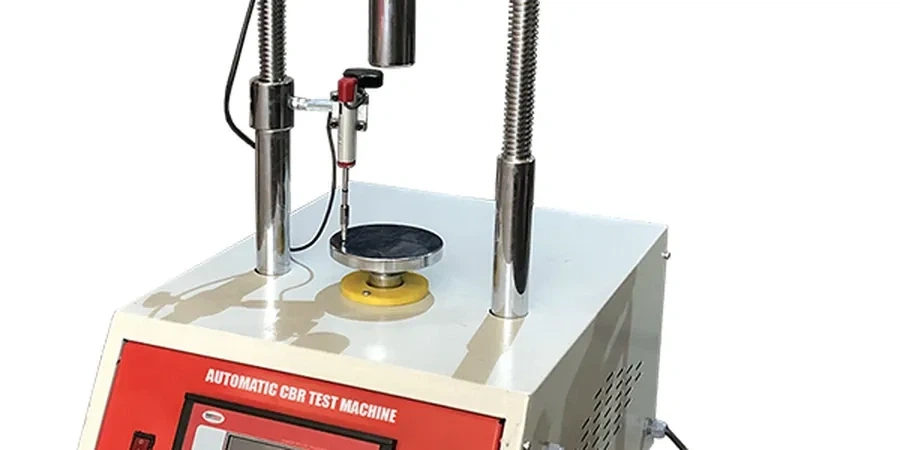
Savannah’s historic grid, laid out by Oglethorpe in 1733, sits on Pleistocene and Holocene deposits that challenge modern pavement engineers. The city’s average elevation of just 6 meters above sea level, combined with a subtropical climate delivering over 1200 mm of annual rainfall, means subgrade soils stay wet. That moisture wrecks unbound granular layers if the strength isn’t verified. We run the laboratory CBR test under controlled conditions to give you a direct measure of bearing capacity. For road projects near the marsh edges or in fast-growing areas like Pooler, we often pair soaked CBR values with a field density check to confirm compaction before paving begins.
A CBR of 3% versus 6% is the difference between a 30-year pavement and a 4-year failure in Savannah’s wet-dry cycles.
Process and scope
Local ground factors
Chatham County’s geologic map shows extensive Wando Formation sands and Pamlico clays, with the water table often at 1.2 to 1.8 meters depth. When a CBR test is skipped or done only on air-dried samples, the design number can inflate by 40% above the soaked reality. That gap leads to under-designed asphalt thickness, fatigue cracking, and base failure within two summers. The Savannah River corridor adds another layer: alluvial silts with organic lenses that lose strength fast when saturated. Our lab refuses to report unsoaked-only values for permanent pavement design. We also cross-check with grain size analysis when the fines content exceeds 35%, because CBR alone doesn’t tell you whether the material will pump fines into the base course under traffic.
Reference standards
We conduct California Bearing Ratio tests in accordance with ASTM D1883-21 and AASHTO T-193-22, utilize ASTM D1557-12(2021) for modified compaction, and follow GDOT Standard Specifications Section 301 for soil-cement construction.
Other technical services
Soaked Laboratory CBR
After compaction, specimens are immersed for 96 hours under annular surcharge weights. We report CBR values at 2.54 mm and 5.08 mm penetration, along with stress-penetration curves and swell percentage, which support subgrade acceptance for GDOT and municipal roads.
CBR with Lime/Fly Ash Stabilization
Specimens for stabilizing Savannah’s high-plasticity clays are mixed with stabilizers per the mix design, cured, soaked, and penetrated to verify strength gain before base course installation.
Typical parameters
Q&A
How much does a laboratory CBR test cost in Savannah?
A standard three-point CBR test on one soil type costs between US$130 and US$240, depending on whether only the unsoaked or the full 96-hour soaked procedure is required. Stabilized CBR testing with lime or cement incurs additional fees per mix design point.
What is the minimum CBR value GDOT requires for subgrade?
GDOT generally mandates a minimum soaked CBR of 6% for subgrade soils. Lower values necessitate stabilization or removal and replacement with select fill. We provide the lab data, and your pavement engineer sets the final acceptance criteria.
How long does it take to get CBR results?
Turnaround time is four business days from sample receipt, largely due to the 96-hour soaking period. If the compaction curve is already known, unsoaked CBR results can be delivered in two days. Expedited service is available for active construction holds.
Can you test aggregate base course with CBR?
Yes, we test graded aggregate base and subbase materials per AASHTO T-193. For GDOT Class I aggregate, lab CBR on base course typically exceeds 80%. Coarse materials are tested using a larger mold and modified compaction effort.