Savannah’s growth didn't start at the port—it started with the water table. The city sits on a Pleistocene terrace dissected by tidal creeks, underlain by the Miocene-age Hawthorn Formation and deeper limestone of the Floridan aquifer. Every deep excavation or foundation in downtown Savannah eventually confronts a simple question: how fast does water move through these layers? In our experience, field permeability tests using the Lefranc method in granular overburden or Lugeon tests in weathered limestone give the only reliable answers. We run these tests on active job sites from Bay Street to Pooler, often in combination with in-situ permeability borehole arrays and CPT soundings that map the stratigraphy before we isolate test intervals.
A Lugeon value above 10 in Savannah’s limestone means you’re not just dealing with porosity—you’re dealing with open conduits that can carry tidal head inland.
Process and scope
Local ground factors
In Savannah, Georgia, the contrast between a site on the sandy Pleistocene terrace near Hunter Army Airfield and one on the alluvial clays of Hutchinson Island is significant. At Hunter, Lefranc tests typically yield values of 10^-3 to 10^-4 cm/s, making dewatering with wellpoints effective and drawdown predictions fairly reliable. Conversely, Hutchinson Island, underlain by soft marsh deposits over solution-weathered limestone, presents a different challenge. Lugeon tests there can vary dramatically, from 5 Lu to 60 Lu within a single 10-foot stage, indicating karstic voids connected to the river. The primary risk in Savannah is not average permeability but vertical heterogeneity. Relying on a single borehole log misses thin sand seams that serve as hydraulic highways. Excavations have flooded because a 6-inch silty sand lens, undetected in SPT split-spoon samples, linked the excavation bottom to a tidal creek 200 feet away. Therefore, we mandate packer-isolated testing at multiple depths.
Reference standards
Relevant standards and guidelines include ASTM D6391-11 for field measurement of hydraulic conductivity via borehole infiltration, USBR Earth Manual Part 6525 for water pressure testing in rock using the Lugeon method, USACE Savannah District Geotechnical Guidelines for permeability testing in levee and dam projects, and FHWA-NHI-05-037 for dewatering and permeability aspects of soil slope and foundation design.
Other technical services
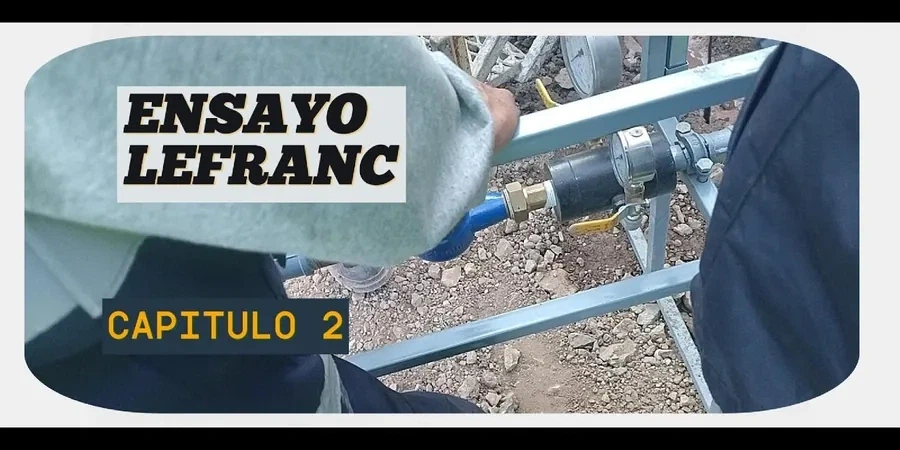
Lefranc Variable-Head Tests
We isolate a screened section in soil and monitor water level recovery rate. Data are analyzed using Hvorslev or Bouwer-Rice solutions, and results are reported as hydraulic conductivity per interval.
Lugeon Pressure Testing in Rock
A five-stage pressure test (low-high-low-high-low) is conducted in fractured limestone or marl. Results are plotted as Lugeon value versus pressure, enabling interpretation of the fracture flow regime—whether laminar, turbulent, dilation, or washout.
Dewatering Parameter Package
Combining Lefranc tests, laboratory grain size curves, and CPT pore pressure dissipation data, we provide estimates of transmissivity and storativity, along with recommended well spacing for your dewatering contractor.
Typical parameters
Q&A
What is the difference between a Lefranc test and a Lugeon test?
The Lefranc test, per ASTM D6391, measures hydraulic conductivity in soil by injecting or recovering water through a screened borehole section. The Lugeon test, applied to fractured rock, involves pumping water into an isolated interval under controlled pressure, with water take expressed in Lugeon units. In Savannah, we employ Lefranc tests in overburden sands and clays and switch to Lugeon tests when encountering the Hawthorn limestone.
How deep can you run permeability tests in the Savannah area?
Our NQ drill string routinely reaches 120 feet, sufficient for most foundation and dewatering depths in Chatham County. For deeper investigations into the Floridan aquifer, we can extend using HWT casing, though most Savannah projects do not require depths beyond 100 feet unless tunneling or deep well injection is involved.
How much does a field permeability test program cost in Savannah?
A standard program involving 3 to 5 Lefranc tests or Lugeon stages typically costs between US$710 and US$1,010 per test interval. This includes drill rig time, packer setup, data acquisition, and the engineering report. The total cost depends on depth, number of intervals, and whether we are already on site for SPT drilling. We provide a fixed-price proposal after reviewing your boring logs.
How many test intervals do I need for a dewatering design?
The required number of tests depends on stratigraphic complexity. In the terrace sands south of Savannah, 3 to 4 Lefranc tests spaced vertically across the proposed excavation depth are usually adequate. On Hutchinson Island or near tidal creeks, where limestone is shallow and fractured, we recommend 4 to 6 Lugeon stages plus at least 2 Lefranc tests in the overburden to fully characterize the hydraulic profile.