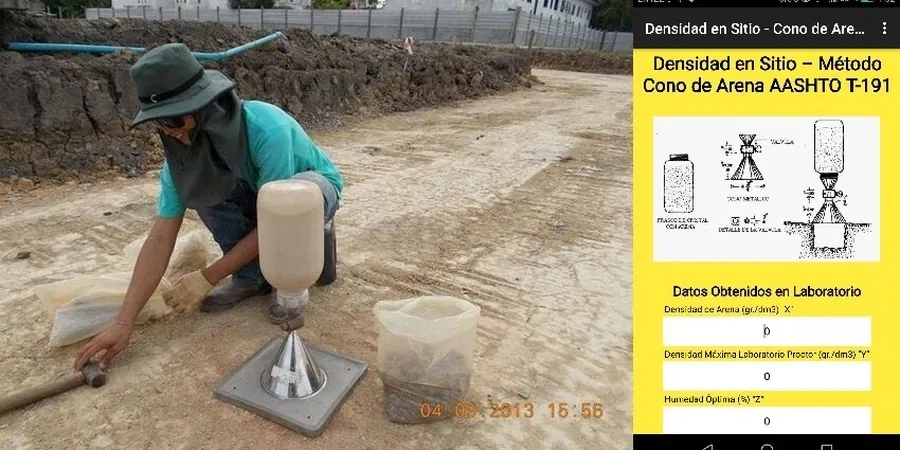
In Savannah, field density testing using the sand cone apparatus verifies compaction in each layer under the hot Georgia sun. The calibrated sand jar rests on the base plate as graded Ottawa sand flows steadily into the excavation. Sites like roadbeds along Abercorn Street, building pads near the marsh edge, and utility trenches in silt-rich ground require verification beyond visual inspection. ASTM D1556 governs the entire procedure from cone calibration to final density calculation, and the lab holds ISO 17025 accreditation for every device used on site. Many areas in Savannah have a water table only three feet below the surface; fill that appears solid after compaction can weaken overnight if density is insufficient. The field crew measures wet density on-site, then dries samples at 110°C in the Savannah lab to determine moisture content and compute dry density against the Proctor maximum—a curve established for the specific borrow source for the project.
A single failing density test on a utility trench backfill in Savannah can delay paving by a week while the contractor reworks the lift.
Process and scope
Local ground factors
Savannah’s colonial grid, laid out by James Oglethorpe in 1733, placed the city on a forty-foot bluff above the Savannah River—but the expansion westward and southward since the 1950s has pushed development onto low-lying Quaternary terrace deposits and back-barrier marsh sediments. These soils compact well in the lab but behave differently under production rollers when humidity spikes or a summer thunderstorm saturates the fill before testing. Under-compacted structural fill beneath a slab-on-grade in these areas can settle differentially by two inches or more within the first four years, cracking partition walls and racking door frames. The sand cone test provides the direct density measurement that a proof roll cannot: it quantifies whether the contractor achieved the specified relative compaction—typically 95 percent of the modified Proctor maximum for building pads per IBC Section 1804, or 98 percent for pavement subgrade under GDOT specifications—before the next lift covers the evidence. For deep fill sections over compressible marsh clay, the field density data also feeds the settlement analysis that the slope stability evaluation requires when fill slopes exceed eight feet near property boundaries.
Video overview
Reference standards
Key standards referenced include ASTM D1556-15e1 for sand-cone density testing, ASTM D1557-12e1 for modified Proctor compaction, IBC 2021 Section 1804 covering excavation and fill, and GDOT Standard Specification Section 210 for roadway embankments.
Other technical services
Compaction Curve Development
Prior to fill placement, borrow samples undergo standard and modified Proctor tests per ASTM D698 and D1557 to determine target density and optimum moisture content, which then serve as benchmarks for subsequent sand cone field tests.
Routine Lift Verification
Sand cone testing is performed at the frequency specified in the project specifications, with results displayed on control charts that indicate percent compaction and moisture deviation per lift, enabling the earthwork contractor to adjust roller passes or aeration in real time.
Forensic Density Investigation
When settlement or pavement distress indicates possible under-compaction, targeted sand cone tests are conducted on existing fill accompanied by a laboratory re-evaluation of the reference Proctor to assess if the original specification was achievable given the material actually placed.
Typical parameters
Q&A
How much does a sand cone field density test cost in Savannah?
In the Savannah area, individual sand cone field density tests cost between US$110 and US$150 each when part of a scheduled lift-verification program. Pricing varies based on the number of tests per mobilization, travel distance to the project site, and whether the lab supplies the Proctor reference curve or the contractor provides one.
How deep does the sand cone hole need to be?
According to ASTM D1556, the test hole depth must match the compacted lift thickness. For a typical 8-inch loose lift compacting to about 6 inches, the hole should be dug roughly 6 inches deep. The ratio of hole diameter to maximum particle size must be greater than 12:1; therefore, material with particles larger than 1.5 inches necessitates a larger-diameter test method.
Can the sand cone test be used when the soil is wet?
The sand cone method is effective for moist soil but unsuitable for saturated or free-draining materials. Water seeping into the test excavation renders volume measurements unreliable. In areas of Savannah with a high water table, dewatering may be required prior to testing, or the contractor might switch to a nuclear density gauge or drive-cylinder method for saturated conditions.
How many sand cone tests are required per day on a typical Savannah earthwork job?
Testing frequency is dictated by the project specification—typically one test per 1,500 to 2,500 square feet per lift for structural fill, or one per 150 linear feet per lift for utility trench backfill. For a 10,000-square-foot building pad compacted in 6-inch lifts, anticipate around four to seven tests per lift, varying with material uniformity and the engineer's assessment of rolling patterns.