A mixed-use project off Abercorn Street hit groundwater at six feet, turning what looked like a straightforward three-level excavation into a complex shoring problem. The developer had assumed stiff clay based on a nearby site near Forsyth Park, but here we found loose silty sands and organic lenses typical of the Pleistocene terrace deposits. We redesigned the retaining wall system with cantilever walls combined with an underdrain network, because without active drainage the hydrostatic pressure would have overwhelmed any conventional gravity structure. This scenario repeats across Savannah, where the subtle variations in the coastal plain stratigraphy demand a geotechnical approach that goes beyond textbook solutions. For deeper cuts near the river, we often pair the wall design with CPT testing to profile the soft zones continuously, and in areas where liquefiable layers appear we integrate liquefaction analysis directly into the wall's seismic performance assessment.
In Savannah's coastal plain, a retaining wall without a properly designed subdrainage system is a temporary structure, regardless of the reinforcement.
Process and scope
Local ground factors
In Savannah, the error we encounter most frequently is the belief that a 3,000 psi gravity wall backed with a typical twelve-inch gravel layer can function reliably without an uninterrupted subdrain. A segmental block wall on Wilmington Island was examined by us after it had rotated outward only eighteen months into its service life—the contractor had failed to install the drain pipe and instead placed the on-site silty sand directly as backfill, which then lost its shear strength during the summer thunderstorm sequence. To fix it, the entire area behind the wall had to be excavated, a chimney drain fitted, and the reinforced zone rebuilt, costing the property owner roughly three times the original wall budget. A further recurring problem is disregarding the long-term settlement under the wall heel's foundation soil: differential settlements beyond two inches have been recorded by us in walls built on the compressible Hawthorne clays, causing stem cracks and exposing the reinforcement to the brackish groundwater. In Savannah's variable subsurface, a pre-construction settlement analysis—which uses consolidation data from incremental load tests—together with an appropriately sized key, can stop these costly post-construction fixes.
Video overview
Reference standards
The codes and standards we apply include IBC 2021 Section 1807 for retaining walls, ASCE 7-22 Chapter 3 for dead, live, and earth pressure loads, AASHTO LRFD Bridge Design Specifications 9th Edition (2020) Section 11 for abutments, piers, and walls, ASTM D2487-17e1 for Unified Soil Classification, and FHWA-NHI-10-024 as the Earth Retaining Structures reference.
Other technical services
Cantilever and Gravity Wall Design
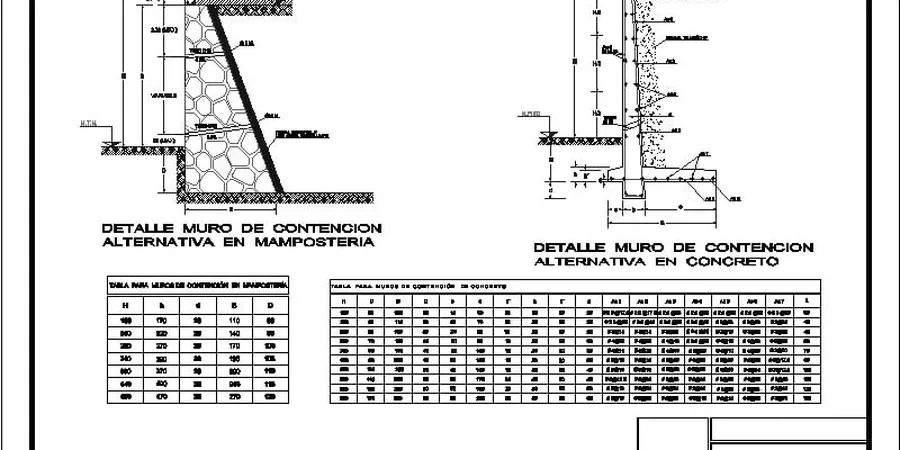
Our design for commercial and residential developments in Chatham County covers reinforced concrete cantilever walls and MSE gravity walls. We assess global stability with Spencer's method, check bearing capacity on Cooper Marl or Hawthorne Group, and verify sliding and overturning according to AASHTO LRFD. Each submittal package includes construction drawings with drainage details, backfill specifications, and a staged inspection schedule.
Temporary Excavation Support and Shoring
For deep excavations near existing structures in Savannah's Historic District, we design soldier pile and lagging systems, sheet pile walls, and soil nail walls. The excavation sequence is modeled in PLAXIS 2D to predict lateral deflections and ground surface settlements, and we prescribe tieback pre-loading where adjacent buildings are movement-sensitive. Our shoring design accounts for the high water table by incorporating dewatering and cutoff measures.
Typical parameters
Q&A
How deep a retaining wall can be built in Savannah's coastal soils without tiebacks?
In our experience throughout Chatham County, a cantilever RC wall can reach between twelve and fourteen feet of exposed height when built on Cooper Marl, as long as there's enough embedment and a continuous subdrain. Once you exceed that, the base width and steel quantities get cost-prohibitive; we then normally opt for an MSE wall with geogrid or a soldier pile with tiebacks. The final selection depends on how close property lines are and what the subsurface exploration shows.
What is the typical cost range for a retaining wall design in Savannah?
In the Savannah area, design fees for a standard cantilever retaining wall range from US$1,020 to US$4,740. The exact amount depends on the wall height, site geometry complexity, and required design iterations. The package comprises the geotechnical report, structural calculations, and signed/sealed construction drawings. The wall's construction cost is separate and varies with the chosen system and access conditions.
How do you handle the high groundwater table in Savannah for retaining wall design?
We assume hydrostatic pressure acts over the wall's full height in the absence of a properly designed and maintained drainage system. Our typical detail consists of a twelve-inch thick granular chimney drain encased in a non-woven geotextile, tied into a six-inch perforated HDPE collector pipe at the base that discharges to daylight or a sump pump. The entire reinforced zone is backfilled with free-draining No. 57 stone, and we verify that the outfall can handle a 25-year storm event to avoid water accumulation during Savannah's heavy summer rains.
Do retaining walls in Savannah need to be designed for seismic loads?
Yes, seismic effects must be accounted for. According to IBC hazard maps, Chatham County's spectral acceleration Ss is 0.35g for Risk Category II structures; the site class, frequently D or E in our local soils, can further amplify ground motion. We use the Mononobe-Okabe method as cited in AASHTO LRFD to compute the seismic earth pressure increment and check sliding and overturning under the combined static-plus-seismic load. For walls exceeding twenty feet in height, a Newmark sliding block analysis is also run to estimate the permanent displacement during the design earthquake.