Between the sandy bluffs of the Historic District and the marshy lowlands near the Vernon River, the subgrade beneath Savannah's streets changes radically within half a mile. A pavement section that works perfectly on the Pleistocene sand ridges east of Forsyth Park can fail within five years on the compressible clays downstream toward Thunderbolt. Rigid pavement design here is about managing that transition without letting the slabs crack at the boundary. The Port of Savannah is the third-busiest container port in the country, which means container trucks with legal axle loads up to 80,000 pounds are constantly rolling through industrial corridors. Our team correlates CBR road testing with the AASHTO 93 empirical equation to determine the required PCC thickness, adjusting the modulus of subgrade reaction for seasonal moisture swings that hit Savannah's water table hard between July thunderstorms and October dry spells. For industrial yards near the port, we also pull data from CPT testing to refine the k-value profile before finalizing the slab design.
A rigid pavement on Savannah's coastal clays lives or dies by the subbase drainage detail, because standing water at the slab interface will pump fines through the joints within three wet seasons.
Process and scope
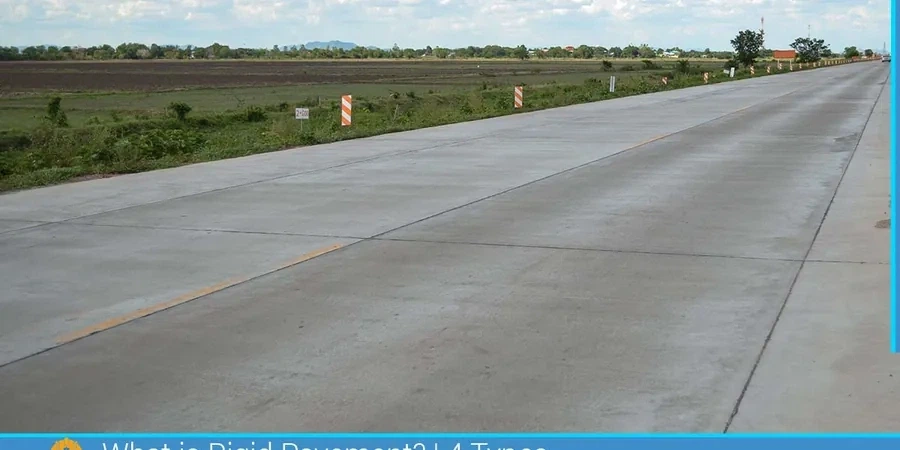
Local ground factors
AASHTO 93 Appendix LL warns that untreated fine-grained subgrades with k-values below 100 pci will pump and erode under repeated heavy axle loads. In Savannah, where the water table sits within three feet of the surface across much of Chatham County from August through October, that warning becomes a design constraint on every project. The biggest mistake we see is specifying a rigid pavement section based on soil borings taken in November when the ground is driest, then watching the slabs fault and crack after the first summer saturation cycle. Loss of support at the slab corner, combined with the thermal curling stresses that hit dark PCC surfaces under the south Georgia sun, can propagate a transverse crack across all four lanes of an arterial within weeks. For port terminal pavements, we now require in-situ permeability testing of the subbase material before placing the concrete, verifying that the coefficient of permeability exceeds 150 ft/day so that water doesn't pond beneath the slab.
Video overview
Reference standards
For designing pavement structures, the AASHTO Guide (1993, with 1998 supplement) is used alongside ASTM C78/C78M for flexural strength of concrete, ASTM D2487 for soil classification (Unified Soil Classification System), the PCA method for concrete pavements on city streets, and ASTM D1883 for the California Bearing Ratio (CBR) of compacted soils in the lab.
Other technical services
Port and Industrial Concrete Pavements
Near the Port of Savannah, our heavy-duty PCC designs cater to container yards, intermodal facilities, and warehouse access roads. We apply the AASHTO 93 empirical method, utilizing site-specific k-values from plate load tests and CPT data. This accounts for 80,000-lb axle loads and channelized traffic patterns, which concentrate stress at slab edges.
Municipal Street and Intersection Design
For arterial roads, school bus routes, and signalized intersections in Chatham County, we design joint layouts and thicknesses. These locations experience high static loads from stopping trucks. Our designs align with the City of Savannah's standard details for curb-and-gutter integration. To maintain load transfer efficiency above 80% throughout the design life, we specify dowel baskets at all transverse contraction joints.
Subgrade Stabilization and Drainage
Using lime or cement, we chemically stabilize Savannah's high-plasticity clays. This is combined with open-graded subbase layers wrapped in geotextile to intercept the seasonal groundwater rise. We verify the treated subgrade modulus through in-situ DCP testing and ensure the drainage coefficient falls within the AASHTO 93 recommended range of 1.0 to 1.2 for coastal Georgia conditions.
Typical parameters
Q&A
What is the typical rigid pavement design life for a Savannah port access road?
Following AASHTO 93 procedures, we design port access roads and container yard pavements for a 20- to 30-year service life. Actual performance depends on the ESAL count, which on high-traffic corridors near the Port of Savannah can surpass 15 million over the design period. We incorporate the terminal growth rate published by the Georgia Ports Authority and adjust the terminal serviceability index accordingly.
How does Savannah's high water table affect rigid pavement joints?
During the rainy months from June to September, the water table in much of Chatham County sits at depths of two to four feet. Without a properly graded subbase and edge drains, water accumulates beneath the slab and pumps fines out through the joints with each heavy axle crossing. This erodes subbase support, leading to faulting and corner breaks. To prevent this, we use AASHTO drainage coefficients and specify geotextile separators between the subgrade and subbase.
What does rigid pavement design cost for a project in the Savannah area?
In the Savannah area, design fees for a standalone rigid pavement engineering package typically range from US$1,920 to US$7,240. The exact amount depends on the project's linear footage, the number of required borings, and the complexity of the joint layout. Projects involving subgrade stabilization design, drainage plans, and coordination with City of Savannah permitting are on the higher end of that range.
Which subgrade tests are required before designing rigid pavement in Savannah?
At a minimum, we require Atterberg limits, grain-size distribution per ASTM D422, and the California Bearing Ratio (CBR) for subgrade and subbase materials. For port pavements, we also recommend in-situ plate load tests or CPT soundings to directly determine the modulus of subgrade reaction. On Savannah's fat clays, we perform moisture-density relationships to set the compaction specification and assess swell potential under the slab.