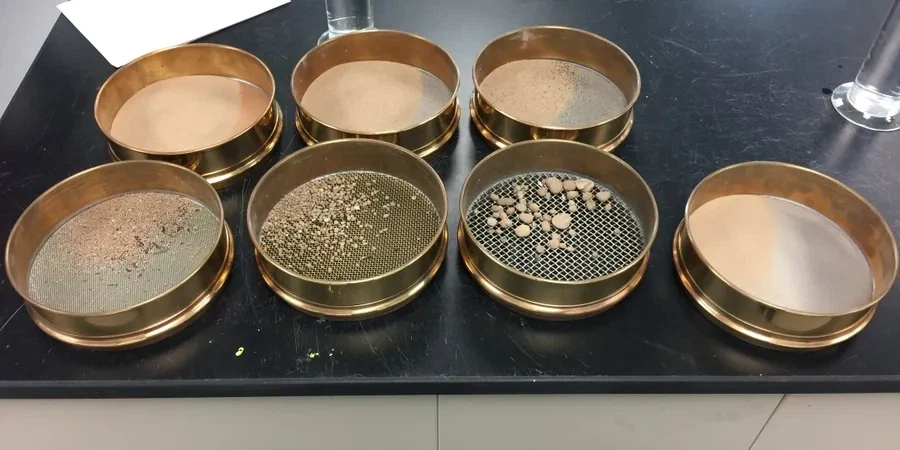
Oglethorpe's 1733 design for Savannah's historic grid is built upon a varied Quaternary stratigraphy of barrier island and back-barrier deposits that can change significantly within a block. The sediment grain sizes, from clean coastal dune sands to inland silty clays and organics from old meander channels, control foundation drainage and liquefaction risk. Our lab has processed many samples from throughout Chatham County, and we recognize that simple visual inspection is insufficient; actual engineering behavior depends on fines content and gradation curve shape. We perform the full mechanical sieve analysis followed by hydrometer testing as one continuous operation, yielding a complete particle size distribution from gravel down to the colloidal clays typical of Savannah's low-lying marsh areas.
A unified gradation curve from 4.75 mm down to 0.001 mm gives you the full story that a simple wash screen never will.
Process and scope
Local ground factors
The difference between the sandy Pleistocene terraces in Ardsley Park and the soft organic clays beneath the lowlands near the Savannah River shows why skipping a thorough grain size analysis is risky. In the higher, well-drained parts of the city, soils are mostly medium to fine sands with minimal silt, and the coefficient of uniformity (Cu) is often less than 2.5, meaning the material is poorly graded and can densify under vibration. Near the waterfront and canal corridors, we regularly find micaceous silts and fat clays where over 60% passes the #200 sieve, with an activity ratio indicating moderate to high swell potential. Treating all Savannah soils as identical in a geotechnical report leads to either an overly conservative and expensive foundation or a pavement that fails early due to frost heave and drainage problems. Our combined sieve-and-hydrometer report allows the design engineer to see exactly where each soil sample falls on the USCS and the construction implications.
Reference standards
ASTM D6913-17 covers sieve analysis for particle-size distribution of soils, ASTM D7928-21e1 covers hydrometer analysis for fine-grained soils, ASTM D2487-17 is the standard for the Unified Soil Classification System, and AASHTO T 88 provides a method for particle size analysis of soils.
Other technical services
Complete Gradation Package (Sieve + Hydrometer)
We provide full particle size distribution from coarse gravel to clay colloids. The sample is oven-dried, split, and washed, then the entire sieve stack is run on a mechanical shaker, after which the fines go into a sedimentation cylinder for a 24-hour hydrometer test with temperature corrections. The final report includes the combined gradation curve, D-values, USCS classification per ASTM D2487, and a brief note about the material's expected engineering behavior based on our Savannah-area experience.
Wash #200 and Sieve Analysis Only
For clean sands and gravels with low expected fines content, we offer a faster, lower-cost option. The sample is washed over a #200 sieve, the retained fraction is dried and sieved, and we report the percent passing as a single value along with the coarse gradation curve. This test suits concrete aggregate qualification, filter sand specification verification, and preliminary site characterization when the hydrometer fraction isn't required by the design brief.
Typical parameters
Q&A
How much sample material do you need for a combined sieve and hydrometer test?
For a standard combined analysis, we typically need about 500 grams for sandy soil and around 200 grams for fine-grained soil. The sample must be representative and contain at least 50 grams of material passing the #40 sieve for the hydrometer test. If shipping from a Savannah job site, we recommend double-bagging in heavy-duty zip-lock bags and labeling each bag with the boring log or test pit number.
What is the typical turnaround time for grain size analysis in your lab?
Standard turnaround is 3 to 5 business days after sample receipt. The hydrometer test requires a minimum 24-hour sedimentation period with frequent readings in the first hour, so the process cannot be sped up physically. For urgent projects in Savannah, we can run multiple cylinders in parallel and provide preliminary D-values within 48 hours, followed by the final signed report.
Do you report the coefficient of uniformity (Cu) and coefficient of curvature (Cc)?
Yes, we compute Cu (D60/D10) and Cc (D30^2/(D60×D10)) on every combined gradation curve. These parameters are vital for evaluating gradation shape and are often needed for filter design, drainage media specifications, and liquefaction assessments. We also flag any values outside typical ranges for Savannah's natural deposits to alert the design engineer for further investigation.
What does a grain size analysis test cost in the Savannah area?
A complete sieve and hydrometer analysis typically ranges from $100 to $200 per sample, depending on the number of samples in the batch and whether we need to run parallel Atterberg limits on the same material. The wash-#200-only option falls at the lower end of that range. We provide a firm quote after reviewing the project scope and sample count. More info.