A five-story mixed-use development half a mile from the Savannah River hit refusal during SPT testing at just 18 feet—loose alluvial sands typical of the lower coastal plain, with blow counts barely reaching N=6. That’s a classic Savannah scenario where conventional shallow foundations become a gamble. We see it regularly from Pooler to the historic district: hydraulic fills and Holocene deposits that can settle under their own weight when saturated. In these conditions, a properly engineered vibrocompaction program can push relative density past 70% and eliminate the need for deep foundations. Our team integrates site-specific CPT data and grain-size distribution to tailor grid spacing, probe frequency, and duration—avoiding the one-size-fits-all approach that fails in stratified coastal deposits. For sites where fines content exceeds 15%, we often combine vibro techniques with stone columns to maintain drainage and densification simultaneously.
Effective vibrocompaction in Savannah’s coastal plain requires treating the soil column as a layered energy system, not a homogeneous mass.
Process and scope
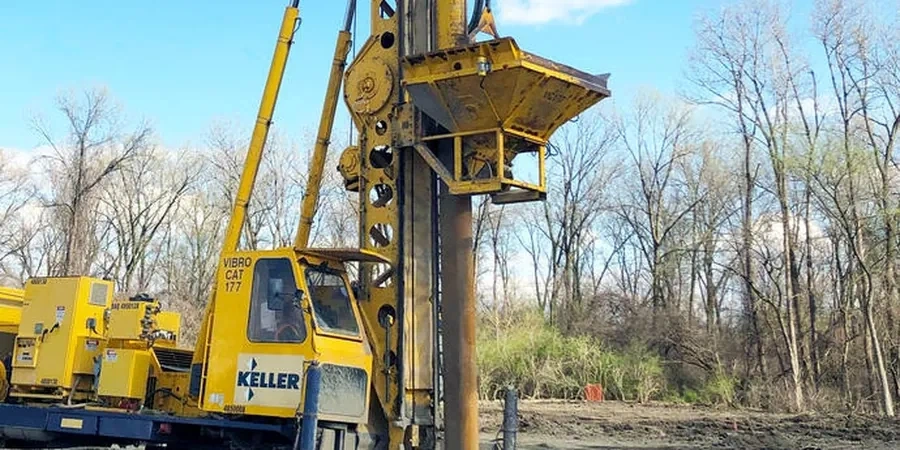
Local ground factors
The subtropical climate in Savannah introduces a risk absent in arid-region vibrocompaction specifications: the water table sits just 4 to 8 feet below grade and fluctuates seasonally due to coastal storm surges and heavy summer rainfall. To compact below the water table, careful control of probe saturation and withdrawal rate is needed to prevent suction-induced loosening. When drainage during compaction was insufficient, we've observed post-treatment settlement of 2 to 3 inches within the first twelve months—an issue easily avoided by combining vibro work with temporary dewatering or wick drains in marginal soils. Savannah's hurricane exposure, being in a 150 mph wind zone per ASCE 7, means densified ground must also resist cyclic degradation during storm surge loading. Our designs incorporate a liquefaction trigger analysis using the NCEER/Youd-Idriss (2001) procedure, ensuring the treated soil achieves a factor of safety above 1.3 for the design earthquake. Shallow artesian conditions in the Savannah area can also cause unexpected pore pressure buildup during probe penetration, requiring continuous monitoring via adjacent piezometers.
Reference standards
We follow several key standards: ASTM D1586-18 for Standard Penetration Test (SPT), ASCE 7-22 for minimum design loads, IBC 2021 Chapter 18 on soils and foundations, FHWA NHI-16-072 on ground improvement methods, and the Youd-Idriss 2001 NCEER procedure for liquefaction triggering based on SPT data.
Other technical services
Vibrocompaction Treatment Design & Test Section Supervision
Our deliverable includes a complete design package: grid layout, energy input specifications, and on-site supervision of the test section execution. Before production compaction begins, we correlate real-time probe ammeter data with CPT tip resistance to finalize spacing and duration.
Post-Treatment Verification & Settlement Monitoring
We execute and interpret post-compaction SPT or CPT borings on a staggered verification grid. Additionally, we install settlement plates and piezometers for long-term monitoring of consolidation and pore pressure dissipation in Savannah's high-water-table environment.
Typical parameters
Q&A
How do you determine if vibrocompaction will work on a Savannah site with silty sand?
The critical parameter is fines content. We perform sieve and hydrometer analysis per ASTM D2487 on representative samples from the target zone. If fines (passing #200 sieve) exceed 15%, pure vibrocompaction loses efficiency because silt particles dampen vibratory energy transmission. In those cases, we evaluate a hybrid approach—such as vibro-replacement stone columns or compaction grouting. We also examine the coefficient of uniformity; well-graded sands in Savannah's older terraces respond better than uniform hydraulic fills near the river.
What does vibrocompaction design cost for a typical commercial building site in Savannah?
For a mid-size commercial lot in the Savannah area—say 20,000 to 40,000 square feet with treatment depths between 25 and 40 feet—the design package, including test section supervision and post-treatment verification, typically ranges from US$1,630 to US$4,670. The variation depends on site complexity: number of verification borings, groundwater monitoring requirements, and whether a full CPT campaign is needed before finalizing the grid.
How long after vibrocompaction can we start foundation construction?
We require a minimum waiting period of 3 to 7 days for post-treatment verification testing to allow excess pore pressures to dissipate in Savannah's fine sands. If CPT results confirm the target relative density has been achieved, foundation work can proceed immediately after verification. For sites with marginal silt content, we may recommend settlement monitoring over 4 to 6 weeks to capture any delayed compression.
Does vibrocompaction affect adjacent structures in downtown Savannah?
Yes, vibration propagation is a legitimate concern in Savannah's historic district, where 1800s-era masonry buildings are sensitive to ground movement. We set up a vibration monitoring plan with seismographs at property lines, limiting peak particle velocity to 0.5 in/s for historic structures per industry practice. In some cases, we reduce probe energy near the site perimeter or install a pre-excavated isolation trench to attenuate surface waves.